




The AI Adoption Playbook: How to Drive Real Transformation in Sales Organization
Revenue leaders across industries are having the same frustrating conversation. They invest in AI technology, get excited about the possibilities, roll it out to their teams and then watch adoption rates plateau at 15-20%.
The demos were impressive, the ROI projections looked promising, but six months later, reps are reverting to old habits and boards are asking tough questions.
But it’s not because the technology doesn’t work. It’s because organizations are treating low levels of AI adoption as a technology problem when it’s actually a people problem.
Michael Ocean, CEO of SellMeThisPen, has experienced this challenge firsthand. His AI sales coaching platform helps teams practice conversations through roleplaying scenarios and analyze real sales interactions to improve performance. Through working extensively with sales organizations across all segments, from SMB to mid-market to post-IPO enterprises worldwide implementing SellMeThisPen, Michael has observed the common patterns that determine success or failure. He learned that successful AI adoption isn’t about finding the perfect tool or writing sophisticated prompts. It’s about understanding human psychology, building trust, and creating sustainable change that actually drives results.
In this article, we’ll explore Michael’s insights on why most AI implementations fail and how to drive genuine adoption that transforms sales performance.
Why Most AI Implementations Fail
To understand how to fix AI adoption, we must first examine why so many initiatives crash and burn despite good intentions and significant investments.
The biggest mistake revenue leaders make is assuming their teams will naturally embrace AI because it makes logical sense. They focus on features, demonstrations, and mandates while completely ignoring the emotional and practical barriers that prevent real adoption.
Michael observes that most AI implementations are designed to serve the organization rather than the individual user. Reps see these tools as additional work, another system to learn, another process to follow, another way for management to monitor their activities. They don’t see how AI directly solves their daily frustrations or makes their jobs easier.
This disconnect reveals why even well-intentioned initiatives fail: teams resist being changed rather than embracing change that clearly benefits them.
The Trust-First Approach to AI Adoption
The foundation of successful AI adoption is trust, and trust starts with understanding the team’s perspective. Every salesperson wants to succeed, but they’re often skeptical of new initiatives because they’ve been burned before by tools that promised transformation but delivered complexity.
Before introducing any AI technology, successful leaders have honest conversations with their teams asking the following questions about their daily challenges:

Michael emphasizes a key insight: people don’t resist change – they resist being changed. When leadership positions AI as something they’re implementing to help teams rather than something they’re requiring teams to do, the entire dynamic shifts. Instead of compliance, organizations get curiosity.
A Step-by-Step Framework for Driving Adoption
While building trust creates the foundation for success, revenue leaders need concrete steps to transform that trust into meaningful adoption and results. Based on Michael’s observations of successful implementations, here’s the tactical approach that actually works:
Step 1: Lead by Example
Before asking teams to adopt AI, leadership must master it themselves. Using AI tools for research, call preparation, and strategic thinking creates authentic credibility. Teams respond to “here’s how this helped me” much better than “you should try this.”
Step 2: Start with Champions
Successful implementations identify 2-3 high-performing reps who are naturally curious and open to experimentation. Working closely with these early adopters helps:
- Discover practical applications
- Refine approaches
- Generate authentic success stories
- Create internal marketing momentum
Step 3: Focus on Immediate Value
The most effective AI applications deliver obvious, immediate benefits. For example:
- Using AI to research prospects and create personalized talking points
- Cutting 30 minutes of preparation time while improving relevance
- Getting real-time assistance during challenging conversations
When reps see tangible time savings and performance improvements, adoption becomes organic rather than forced.
Step 4: Create Safe Learning Environments
Implementing regular “AI labs” where teams experiment with different tools and share discoveries removes pressure while building expertise. This collaborative approach focuses on exploration rather than perfect execution, making learning engaging rather than stressful.
Step 5: Shift from Evaluation to Enablement
The most successful organizations stop tracking who’s using AI and start celebrating improved performance metrics. When team members connect AI usage to personal success: better meeting conversion rates, faster deal velocity, higher quota attainment – the behavior becomes self-reinforcing.
Building Long-Term Transformation
Once initial adoption takes hold, the focus shifts from getting teams to use AI to maximizing its transformational impact on sales performance and business results. The most successful AI adoptions evolve beyond simple tool usage to fundamental workflow transformation. This progression typically follows three phases:
Phase 1: Preparation and Practice
Teams use AI for preparation and practice, engaging in role-playing scenarios, researching prospects, and crafting personalized messaging while building familiarity without disrupting existing processes.
Phase 2: Live Integration
AI becomes integrated into live sales activities. Reps receive real-time assistance during calls, get help handling objections instantly, and access relevant information on demand. The technology becomes a trusted co-pilot.
Phase 3: Strategic Intelligence
AI provides strategic insights by analyzing patterns across deals, revealing which approaches drive results and where individual reps need development.
Tools like SellMeThisPen help teams not just practice better conversations through AI role-playing, but also analyze real sales interactions to improve actual performance.
Michael notes that the critical factor in this evolution is ensuring each phase delivers measurable value before progressing to more sophisticated applications. Teams need to experience success at each level to maintain momentum.
Overcoming the Adoption Plateau
Even successful implementations often hit a plateau where initial enthusiasm fades but habits haven’t fully formed. This is the make-or-break moment for AI adoption initiatives.
The solution is creating reinforcement mechanisms that make AI usage feel rewarding rather than required:
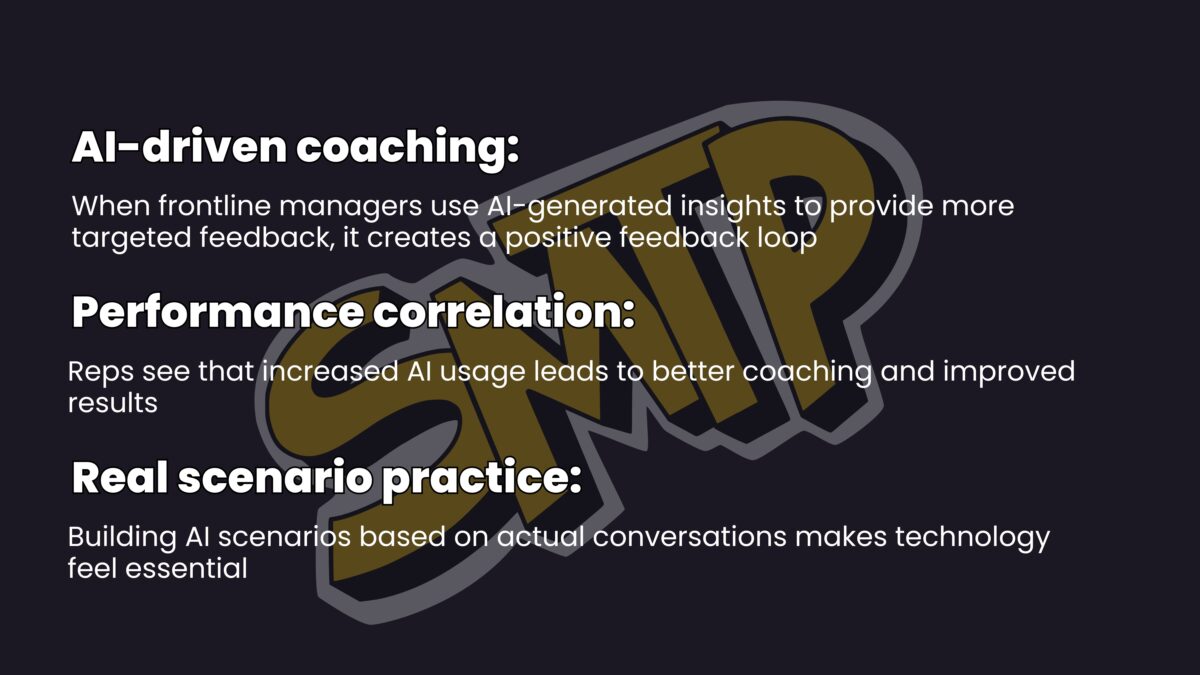
Another powerful technique Michael has observed is building AI roleplay scenarios based on real conversations teams have experienced. Instead of generic practice, creating simulations that mirror actual challenges with specific prospects makes the technology feel essential rather than optional.
Conclusion
The organizations that successfully navigate these adoption challenges position themselves for sustained competitive advantage as AI capabilities continue advancing at an unprecedented pace.
Michael emphasizes that the goal isn’t to replace human capabilities but to amplify them. The most successful AI implementations help salespeople become more strategic, more prepared, and more effective in the uniquely human aspects of selling—building relationships, understanding complex needs, and navigating organizational dynamics.
The companies that master AI adoption won’t be those with the most sophisticated technology, they’ll be those that best understand how to blend tools with fundamental human principles of trust, communication, and continuous learning. Ultimately, AI adoption success depends on whether teams see the technology as a burden or a benefit. Make it clearly beneficial, and adoption becomes inevitable.
Table of Contents
Share this article
Sign up for Insights
Learn from the brightest minds how to predictably and efficiently grow revenue.
Related Content
Why 52% of New Revenue Now Comes From Existing Customers
In this episode of Revenue Insights, host Guy Rubin sits down with Ben O’Mathuin, Principal Consultant at Customer Lift, to explore how companies can transform Customer Success (CS) from a retention function into a strategic revenue driver. Discover why traditional QBRs are becoming obsolete, how to create meaningful C-suite engagement, and the practical frameworks for…
The Essential Sales Tech Stack for Startups (Without the Bloat)
A sales tech stack is the collection of tools your sales team uses every day to generate pipeline, connect with prospects, and close deals.
Ebsta and Fullcast: Better Together
In 2021, Gartner research predicted that 75 percent of companies would be using a RevOps model by the end of 2025. Revenue operations is arguably the most talked-about topic in recent months. However, it still feels like the revenue engine powering most go-to-market teams today is running on fumes, and no one’s admitting it. Misaligned…