


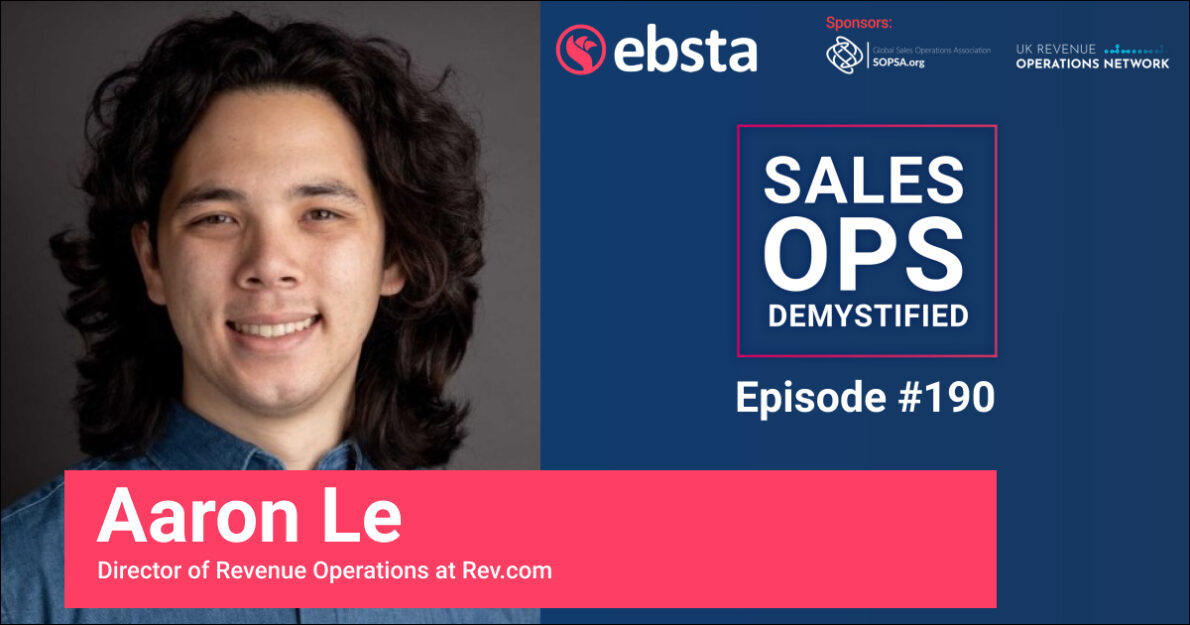

A Shared Sales Reality with Aaron Le, Director of Revenue Ops at Rev.com
In this episode of Sales Ops Demystified, Tom Hunt and Alex Freeman are joined by Aaron Le, Director of Revenue Ops at Rev.com. They discuss why it’s important to move from a fragmented sales ops structure into a unified Rev Ops team, what makes the biggest difference in throughput for Rev Ops teams, and the process of documenting your sales process as you grow.
Transition to Sales/Rev Ops
Aaron moved from Corporate FP&A and his first new role was Sales Ops. He enjoyed doing Sales Ops because he finds generating revenue much more exciting than financial planning and budgeting. He also loves the helping-oriented nature of the role.
Most important stakeholder for a Sales/Rev Ops professional
The hierarchy starts with the customer at the top, followed by the business, followed by sales reps. Finding a way to add value to customers in a scalable way is the most important part of a high-performing business.
Rev Ops team structure at Rev.com
They have 35 sales reps and 10 rev ops professionals. This ratio is higher because Aaron’s team has recently started focusing on B2B sales reps in addition to regular B2C sales reps as well.
Should your company transition from Sales Ops to Rev Ops?
Because they had a decentralized operations framework, they also had decentralized systems ownership and that resulted in different organizations – sales, and marketing – optimizing for those subsystems. This made handoffs more painful and they lacked one view of the entire customer journey. Likewise, there’s no single owner for revenue numbers when working in this decentralized model.
With a unified Rev Ops approach, they provide unbiased data analysis and have a direct seat at the table with the Chief Revenue Officer (CRO). Instead of reporting to respective sales or marketing leaders, they can objectively assess how the business is doing in sales and marketing and push back on them in a healthy manner.
Within Rev.com, this transition kickstarted when their current VP of Sales proposed a transition to go the B2B route. As work started on this hypothesis, they found more growth opportunities, and eventually, the dominoes of obstacles in the way of higher revenue started falling.
What makes the biggest difference in Rev Ops?
They have an ongoing project to document the Sales process to create a single shared reality as their Sales and Rev Ops teams grow in number. This also means coming with internal certifications that will allow them to onboard and manage new reps efficiently.
A second important step for Rev.com’s Rev Ops team is creating a single dashboard for the revenue team to refer to as they work to develop its rep-level customizations.
Creating useful insights that go beyond the dashboard
The best way to extract useful insights other than the dashboard is to look at the sales reps’ journey in connection to the journey of the rest of the company. It’s important that sales reps see how their work contributes to something bigger than themselves.
The ultimate large-scale goal is to help sales reps realize the vision of the sales leaders and the rest of the management team.
The process of documenting your sales process
It starts by getting the team and the VP of Sales aligned on what the shared reality of sales looks like. Gathering buy-in from these other leaders earlier in the process, before you start doing all the work, is going to set you up for success when it comes to adoption.
It’s also important to make sure accountability comes from healthy conflict by being great partners who are positive, solution-oriented, and collaborative.
Recommended episodes
- The Six Pillars of Revenue Operations with Rhys Williams, VP Revenue Operations at Convercent
- SVP, Revenue Operations, Strategy, and Enablement: Carolyn Mellor of Procore Technologies
- Making Sales Ops More Actionable with Ethan Trombley, Director of Revenue Operations at Keyfactor
Subscribe To Sales Ops Demystified:
Table of Contents
Share this article
Sign up for Insights
Learn from the brightest minds how to predictably and efficiently grow revenue.
Related Content
Why 52% of New Revenue Now Comes From Existing Customers
In this episode of Revenue Insights, host Guy Rubin sits down with Ben O’Mathuin, Principal Consultant at Customer Lift, to explore how companies can transform Customer Success (CS) from a retention function into a strategic revenue driver. Discover why traditional QBRs are becoming obsolete, how to create meaningful C-suite engagement, and the practical frameworks for…
This VP Grew Revenue from $15M to $45M Using These Sales Strategies | Mikey Abts
In this episode of Revenue Insights, host Guy Rubin sits down with Mikey Abts, Vice President of Sales at Recast Software, to explore the evolving landscape of sales-generated opportunities. With a unique career path spanning law, litigation finance, and enterprise sales at SAP Concur and Nintex before leading global sales at Recast, Mikey brings a…
Why 75% of Sales Deals Fail (And How AI Can Fix It)
In this episode of Revenue Insights, Guy Rubin sits down with Vanessa Metcalf, VP of Global Revenue Enablement at Showpad, to explore the evolving landscape of sales enablement. With over 18 years of experience spanning sales, enablement, and strategic operations, Vanessa offers invaluable insights on measuring enablement effectiveness, driving cross-functional alignment, and leveraging AI to…